
Crypto and Islam in Pakistan: The Complete Record
Darul Uloom Karachi ruled cryptocurrency impermissible in June 2026. The ruling, its reasoning, the regulator's response, and where scholarly opinion stands — reported, not adjudicated.

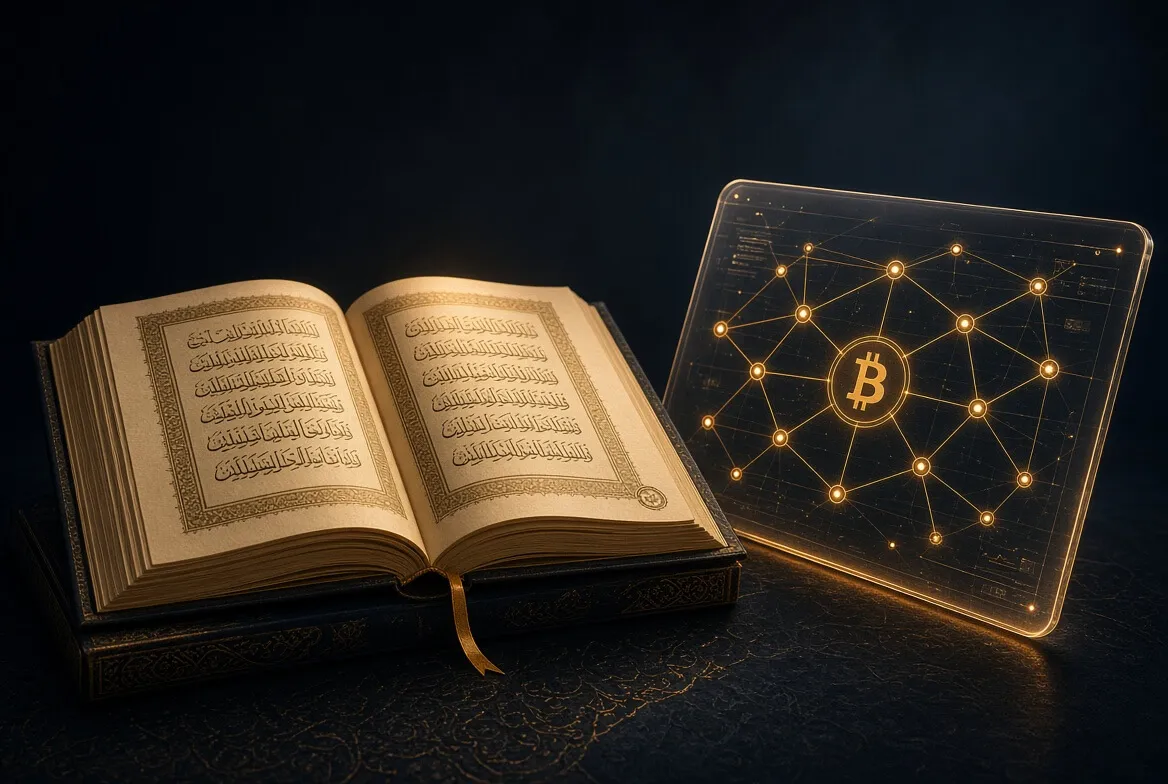
Is Bitcoin haram in Islam?
Scholarly opinion is divided. On 10 June 2026, Darul Ifta at Jamia Darul Uloom Karachi issued a fatwa, signed by Mufti Muhammad Taqi Usmani and six other scholars, holding that transacting in cryptocurrency, including Bitcoin and stablecoins such as USDT, is not permissible under Islamic law. Scholarly opinion across the Muslim world remains divided. This page records the debate; it does not issue a ruling.
Summary
On 10 June 2026 (24 Zilhaj 1447 AH), Darul Ifta at Jamia Darul Uloom Karachi
issued a fatwa, signed by Mufti Muhammad Taqi Usmani and six other scholars,
holding that transacting in cryptocurrency is not permissible under Islamic law.
The ruling covers Bitcoin, crypto tokens generally, and stablecoins including USDT.
Pakistan's crypto regulator has not disputed the ruling but has asked the seminary
to distinguish between categories of digital asset. Scholarly opinion across the
Muslim world remains divided.
This page is the maintained record of that debate.
The fatwa
Issued by: Darul Ifta, Jamia Darul Uloom, Karachi
Date: 24 Zilhaj 1447 AH / 10 June 2026
Principal signatory: Mufti Muhammad Taqi Usmani — President of Wifaq-ul-Madaris
Al-Arabia Pakistan and of Darul Uloom Karachi
Co-signatories: reported as six additional scholars of the seminary. We have not
obtained the original document and cannot list them by name.
The reasoning
The ruling turns on whether cryptocurrency qualifies as māl (مال — wealth or
property) in the Sharia sense. The fatwa holds that it does not.
As reported, the ruling states that cryptocurrency:
On that quotation: it is a translation as carried in Pakistani news coverage.
We have not seen the original Urdu or Arabic text, and we are not offering our own
translation. Read it as reported wording, not as the authoritative text of the ruling.
The consequence the fatwa draws: because crypto is not māl, a person paying in
crypto does not effect a valid transfer of ownership, and so buying and selling
goods or conducting financial transactions through cryptocurrency is impermissible
— regardless of whether the instrument is a stablecoin such as USDT or another token.
What it covers
- Bitcoin and Ethereum
- Blockchain-based tokens generally
- Stablecoins, explicitly including USDT
What remains to be clarified
The published reporting does not fully resolve how the ruling applies to:
- Asset-backed tokens (gold-backed tokens, tokenised sukuk)
- Fully reserved stablecoins with an enforceable redemption claim
- Tokenised real-world assets
- Holding versus transacting
This ambiguity is precisely what the regulator has asked the seminary to address.
The official response
PVARA Chairman Bilal bin Saqib responded not by contesting the fatwa but by
asking Jamia Darul Uloom to assess digital assets by category rather than as a
single class.
His stated position:
- A blockchain-recorded sukuk represents ownership of a real, income-generating asset
- Gold-backed tokens and fully reserved stablecoins carry an enforceable claim on something tangible and redeemable
- Purely speculative tokens with no underlying asset are a separate matter — and on those, in his words, "the scholars' concerns there must be taken seriously"
Saqib has also held what Dawn described as a "constructive" discussion directly
with Mufti Taqi Usmani on the Sharia status of digital assets.
He stated that the regulator "will continue working closely with our scholars as
Pakistan develops its licensing framework and advances work on stablecoins and
real-world asset tokenisation."
Why this matters: Pakistan's regulatory roadmap leans heavily on stablecoins
and real-world asset tokenisation — exactly the categories where an asset-backed
argument is strongest. The distinction Saqib is requesting is not incidental to the
state's crypto strategy; it is central to it.
Other scholarly positions
Opinion across the Muslim world is not settled.
| Jurisdiction / body | Position |
|---|---|
| Darul Uloom Karachi (Pakistan) | Impermissible — crypto is not māl |
| Egypt — Grand Mufti | Impermissible |
| Various scholars, South Africa | Permissible as a socially accepted medium of exchange |
| Mufti Muneeb-ur-Rehman (Pakistan) | Has stated that no final ruling has been issued on cryptocurrency |
On this table: it is a summary of positions as reported, not a survey with
primary citations, and it is deliberately incomplete. We have not yet examined
AAOIFI, the Islamic Fiqh Academy (Jeddah), Malaysia's Securities Commission Shariah
Advisory Council, Indonesia's MUI, or the UAE scholarly bodies. Read it as a map of
where the disagreement lies, not as a settled account of any body's reasoning.
The Malaysian and UAE positions are especially relevant, since both jurisdictions
run regulated Islamic-finance-compatible digital asset regimes that Pakistan has
studied.
What this means practically
We report; we do not issue rulings. What we can state factually:
- The fatwa is not a law. It does not change the legal status of crypto in
Pakistan, which is governed by the Virtual Assets Act 2026. - Crypto remains legal and in the process of being licensed by PVARA, which has
issued NOCs to Binance and HTX. - For observant Muslims, the fatwa carries religious weight independent of the
legal position. Many readers will treat it as binding. - The regulator and the seminary are in active dialogue. The position may develop.
If you are deciding what to do personally, that is a question for a scholar you
trust, not for a news site.
Timeline
| Date | Event |
|---|---|
| 10 Jun 2026 | Fatwa issued by Darul Ifta, Jamia Darul Uloom Karachi |
| ~9 Jul 2026 | Fatwa circulated publicly; widely reported |
| ~10 Jul 2026 | Coverage in Dawn, Geo, Business Recorder, The Nation, Pakistan Today |
| ~12 Jul 2026 | Mufti Muneeb-ur-Rehman: no final ruling issued |
| ~13 Jul 2026 | Bilal bin Saqib holds discussion with Mufti Taqi Usmani |
| 16 Jul 2026 | PVARA formally requests category-based distinction |
| ongoing | Awaiting seminary response |
On this timeline: reconstructed from Pakistani press reporting. Dates marked ~
are approximate — they reflect when coverage appeared, not necessarily when the
event occurred. The 10 June issuance date is the one given in the ruling itself as
reported.
Last reviewed: 8 August 2026. This page reports the ruling; it does not
adjudicate Islamic law, and we are not qualified to. It has not been reviewed by a
scholar. We have not obtained the original Urdu or Arabic text of the fatwa. Where
we rely on press reporting, we say so in the section concerned.
This page is maintained and will be updated as the seminary and PVARA respond.
Corrections are published, not quietly edited — if you believe anything here
misstates the ruling, tell us and we will correct it.
Sources
- Mufti Taqi Usmani declares crypto-based purchases impermissible under Islamic law — Dawn
- Crypto czar asks Jamia Darul Uloom to distinguish between speculative crypto, asset-backed tokens — Dawn
- Crypto czar holds 'constructive' discussion with Mufti Taqi Usmani — Dawn
- Mufti Taqi Usmani's fatwa rules cryptocurrency purchases impermissible — Geo
- PVARA seeks Shariah distinction between crypto, digital tokens — Geo
- PVARA seeks clarity on crypto under Shariah — Pakistan Today
- Govt seeks seminary guidance on crypto asset categories — Business Recorder
- Mufti Taqi Usmani declares cryptocurrency transactions impermissible — The Nation
- PVARA seeks clarification as fatwa clouds Pakistan's crypto push — The News
- Mufti Muneeb: no final ruling issued on cryptocurrency — TechnologyPlus
We have not obtained the original Urdu/Arabic text of the fatwa. If you can point
us to it, please get in touch — we will link it and revise this page against it.