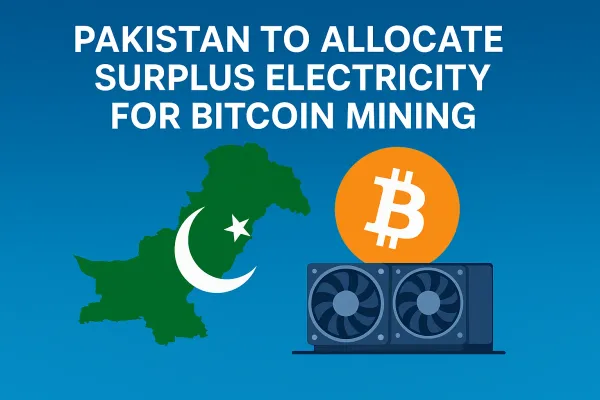
Pakistan Offered Miners 2,000MW. The IMF Said No to Cheap Power
The allocation is real and the duty exemptions are real. The subsidised tariff that made the numbers work is not — and the hash-rate thresholds circulating online cannot be verified.

On 25 May 2025, Finance Minister Muhammad Aurangzeb announced that Pakistan would allocate 2,000 megawatts of surplus electricity to Bitcoin mining and AI data centres. The Pakistan Crypto Council, chaired by Bilal bin Saqib, led the initiative. The Ministry of Finance attached tax incentives for AI centres and duty exemptions for Bitcoin miners.
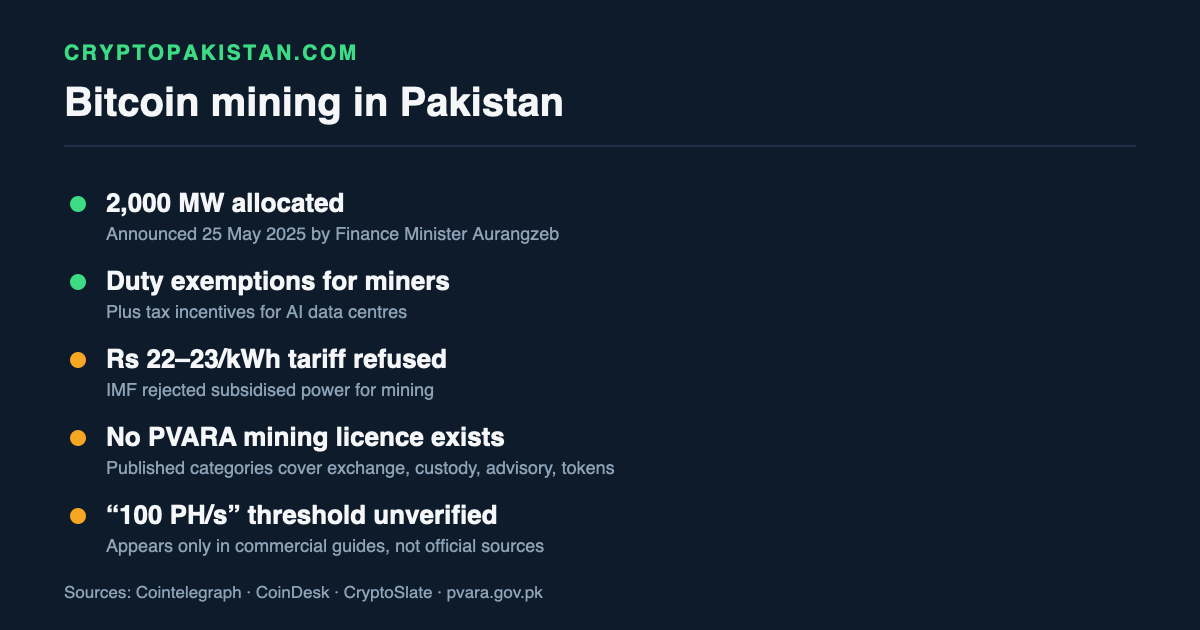
Roughly six weeks later, the plan lost the piece that made it economically interesting. Pakistan's Secretary of Power told the Senate Standing Committee on Energy that the IMF had rejected the proposal to offer subsidised electricity to energy-intensive industries, mining among them.
What was actually proposed
The Power Division's plan, first floated in November 2024, was a marginal-cost tariff of Rs 22–23 per kilowatt-hour for heavy-consumption industries — copper smelting, data centres and crypto mining. Against Pakistan's standard industrial rates, that is the difference between a mining operation that clears its costs and one that does not.
The IMF opposed it on the grounds that a sector-specific tariff could destabilise the power market, and reportedly compared it to the kind of targeted tax break that has repeatedly created economic distortions in Pakistan. This was not the Fund's first refusal on the point: a similar six-month marginal-cost tariff floated in September 2024 was cut back to a three-month arrangement.
What survives, and what does not
- Still standing: the 2,000 MW allocation itself, the duty exemptions on mining hardware, and the Crypto Council's mandate to attract foreign operators.
- Not standing: the discounted power tariff. Miners pay commercial rates.
That distinction matters more than it might appear. Bitcoin mining is a business in which electricity is the dominant input cost. An allocation of capacity is a promise that power will be available. A marginal-cost tariff is a promise it will be cheap. Pakistan has delivered the first and been refused the second, and only the second changes the economics.
A claim we could not verify
A specific set of figures circulates widely in guides to mining in Pakistan: that Phase 1 was limited to international operators exceeding 1 exahash per second, and that Phase 2 opened in early 2026 to domestic miners with a minimum of 100 petahashes per second.
We could not find those thresholds in any government announcement, Crypto Council statement or credible news report. They appear almost exclusively in commercial "crypto mining in Pakistan" guides that cite each other. The most substantive contemporaneous reporting describes the phases differently — Phase 1 directing surplus power to mining and AI, Phase 2 introducing access to renewable energy, with no hash-rate qualification mentioned at all.
We are flagging this rather than repeating it. If you are budgeting a mining operation around a 100 PH/s entry requirement, you are planning against a number with no traceable source. If a reader can point us to an official document containing it, we will correct this piece and say so.
What this means for Pakistani users
- Do not assume subsidised power. The tariff was refused. Model your economics at commercial industrial rates.
- The duty exemption is the real incentive that remains — it lowers the cost of importing hardware, not the cost of running it.
- Treat mining-guide websites with suspicion. The hash-rate thresholds above are the clearest example of a figure that became "fact" through repetition. This is the same pattern as the widely-repeated "15% crypto tax" that has no basis in enacted law.
- Mining sits outside PVARA's current licensing. The categories PVARA has published cover exchanges, custody, advisory and token issuance — not mining. Do not expect a PVARA mining licence to exist just because a website says you need one.
What we're watching
Whether any tariff arrangement for mining is revived in the next IMF review, whether the renewable-energy phase produces a published framework, and whether the Crypto Council names a single operator that has actually energised capacity under the allocation. Fifteen months on from the announcement, that last one is the number that would settle whether this is an industry or a press release.
Sources
- Cointelegraph — Pakistan allocates 2,000MW for Bitcoin mining and AI centres
- Cointelegraph — Pakistan mining plan in limbo as IMF rejects power subsidies
- CoinDesk — IMF turns down Pakistan's proposal to subsidise power for BTC mining
- CryptoSlate — Three-month trial after the IMF's partial rejection
- PVARA — VASP licensing categories (primary)