IMF paper puts Pakistan's stablecoin holdings at $5.8bn
A new IMF working paper estimates that people in Pakistan held about $5.8 billion in stablecoins at the end of 2025, roughly 1.4% of GDP. It also finds that stablecoin use jumps when countries restrict capital outflows or suffer currency crises, and stays high afterwards.

Key takeaways
- An IMF working paper estimates stablecoin holdings in Pakistan at $5.8 billion at the end of 2025, about 1.42% of GDP.
- It finds that when countries restrict capital outflows, stablecoin activity rises about 30% within six months and does not fall back.
- After currency crises, holdings rise about 75% within a year. The paper dates a Pakistani currency crisis to August 2021.
- The figures are model estimates from blockchain data, and the paper states the views are the author's, not the IMF's.
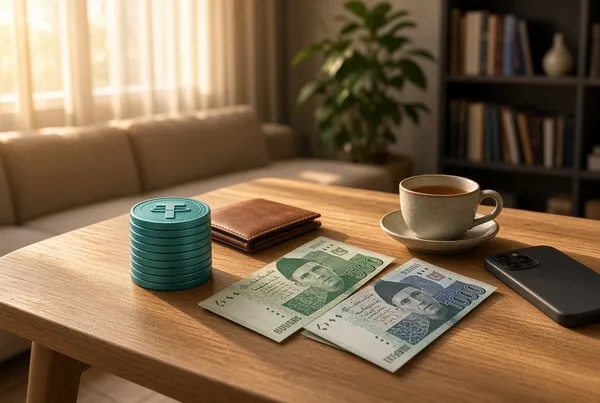
People in Pakistan held an estimated $5.8 billion in stablecoins at the end of 2025, according to an International Monetary Fund working paper published on 2 October. At today's official exchange rate of about Rs277, that would be roughly Rs1.6 trillion.
The paper, by Marco Reuter, puts that at 1.42% of Pakistan's GDP. That is far above the share in the largest economies: 0.04% in the United States and 0.09% in China. It places Pakistan alongside Vietnam, Venezuela, Argentina and Nigeria among the emerging economies with the largest holdings in dollar terms.
The paper's wider point matters more for Pakistan than the single number. It argues that "dollarization may now also operate through stablecoins": when people lose confidence in their currency or face limits on moving money abroad, they increasingly buy digital dollars, and they keep them.
What the paper found
The study builds a country-by-country estimate of stablecoin flows for 188 countries. It counts $21.4 trillion in gross flows between 2018 and 2025. Emerging markets and developing economies, it says, "hold three quarters of stablecoins", and their share has risen since 2020.
The paper estimates holdings at the end of 2025 for several economies:
| Economy | Estimated holdings | Share of GDP |
|---|---|---|
| Türkiye | $13.3bn | 0.83% |
| Ukraine | $8.6bn | 4.05% |
| Vietnam | $6.5bn | 1.31% |
| Pakistan | $5.8bn | 1.42% |
| Venezuela | $5.6bn | 5.61% |
| Argentina | $5.1bn | 0.75% |
| Nigeria | $4.1bn | 1.42% |
Two findings stand out:
- Capital controls. "When countries restrict capital outflows, stablecoin activity rises by roughly 30 percent over the following six months, then plateaus, and does not fall back when restrictions are removed."
- Currency crises. "When currency crises hit, stablecoin holdings increase by roughly 75 percent within a year, and the new holdings persist."
Pakistan appears in the paper's list of currency-crisis events, with an onset in August 2021 under both of the standard definitions it uses. Those definitions are based on sharp falls in the exchange rate. The paper does not report a separate result for Pakistan.
How the estimate was made, and its limits
Stablecoin wallets do not carry a nationality, so the numbers are modelled. The author labelled 437,775 wallets by region, then trained a machine-learning model on their behaviour: the hours they are active, whether their activity shifts with daylight saving time, and the exchanges and tokens they use. The model assigns other active wallets to one of five world regions. The paper then splits each region into countries using the web traffic of the exchanges each wallet deals with.
That method has limits worth keeping in mind:
- It only covers wallets with at least 50 transactions.
- The paper says about 22% of outstanding stablecoins fall outside its estimates.
- Splitting a region into countries by exchange web traffic is an approximation, not an observation.
- It is a working paper. The IMF's standard disclaimer says the views "are those of the author(s) and do not necessarily represent the views of the IMF".
So $5.8 billion is best read as an order of magnitude: billions of dollars, not millions.
What this means for Pakistani users
- You are not unusual. Pakistanis pay more than the official rate for USDT: on 21 October, our P2P premium tracker put the premium at 2.38% over the State Bank's rate. A persistent premium is consistent with the demand for digital dollars the paper describes.
- Holding a stablecoin is holding a company's promise. USDT and similar tokens are only as good as their issuers' reserves and their willingness to redeem. Under PVARA's rules, a dollar token issued in Pakistan would need full reserves and redemption at par. The foreign tokens Pakistanis hold today are not issued under those rules.
- Banks are still outside this. The State Bank's April circular lets banks serve PVARA-licensed firms only, and PVARA's licensing page named no licensee when we checked on 21 October. Our explainer on whether your bank can close your account over crypto covers what that means for P2P traders.
- Persistence cuts both ways. If holdings stay high after a crisis, as the paper finds, savings stay outside the rupee banking system, where deposit protection and complaint routes do not reach.
What we're watching
- Whether the IMF or the State Bank cites stablecoin dollarisation in Pakistan's programme reviews or policy statements.
- PVARA's first licences, including any for issuing fiat-referenced tokens.
- Our own P2P premium series, which gives a daily read on the demand the paper describes.
Sources
- Marco Reuter, "International Stablecoin Flows, Capital Controls and Currency Crises", IMF Working Paper No. 2026/211, 2 October 2026: summary, p.26 and Table 12.
- CryptoPakistan, PKR/USDT P2P premium tracker, daily figure for 21 October 2026.
- State Bank of Pakistan, BPRD Circular Letter No. 10 of 2026, 14 April 2026.
- PVARA, licensing page, read 21 October 2026.