Rs800m and Ten Months: What PVARA Has Actually Delivered
The ECC funded Pakistan's virtual asset regulator in September 2025. Ten months on, here is the verifiable record — what has shipped, and what has not.


On 25 September 2025, the Economic Coordination Committee approved a Rs800 million Technical Supplementary Grant for the Pakistan Virtual Assets Regulatory Authority. The meeting was chaired virtually by Finance Minister Muhammad Aurangzeb from New York. The stated purpose was to strengthen PVARA's institutional capacity, build the regulatory framework, and align Pakistan with FATF standards.
Ten months have passed. Public money was committed to building a regulator, so it is reasonable to ask what it has produced. We have gone through PVARA's own published record rather than press statements.
What has actually shipped
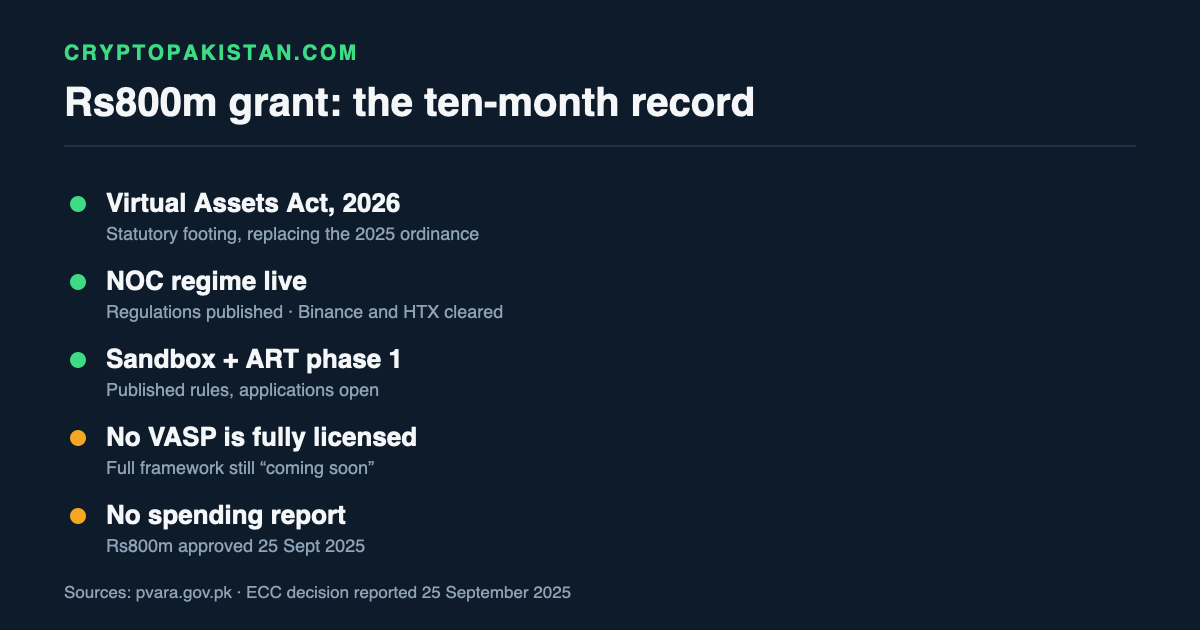
- Primary legislation. The Virtual Assets Act, 2026 passed the National Assembly, replacing the 2025 ordinance PVARA was originally created under. This is the single most consequential item — it moved PVARA from an executive instrument to a statutory footing.
- An NOC regime, live and operating. Applications run through a working online portal, with published NOC regulations.
- NOCs actually issued. Binance and HTX have received them — the first named international exchanges cleared to proceed in Pakistan.
- A regulatory sandbox with published rules. The Sandbox Guidelines 2026 set out eligibility, a 60-working-day evaluation clock, no-action relief, and exit procedures.
- A notified licensing regime, live since 21 August 2026. All eleven Schedule-I categories — including Asset-Referenced Token issuance, previously the only open category — are open for application under the Virtual Asset Services Regulations, 2026 (S.R.O. 1419(I)/2026).
- An advisory function. PVARA/ADV/001/2026, dated 26 April 2026, addresses virtual asset-related announcements and activities.
- A complaints mechanism and a published institutional structure.
That is a real institution-building record. Ten months from a cabinet-created body to primary legislation, a functioning application portal, published regulations and a sandbox framework is not slow by the standards of Pakistani financial regulation.
What has not
The gap is singular and it is large: no VASP in Pakistan holds a full licence.
As of 21 August 2026, that gap has narrowed but not closed. PVARA's licensing page no longer describes the full framework as "coming soon" — the application window is open, and Schedule-I to the notified regulations publishes minimum paid-up capital by category, from PKR 15 million (Advisory Services) to PKR 500 million (Exchange Services and three other categories). What has not happened is a grant: no application has yet produced a full licence.
The practical consequence is that Pakistan has a law, a regulator, a portal, a sandbox and an open application window, but not yet a single licensed exchange. Users transacting today are doing so with platforms that hold, at most, a clearance to proceed.
The claim to watch for
This gap is being blurred commercially. An NOC is regulatory clearance to move forward with registration and compliance steps. It is not authorisation to operate as a licensed provider. Any platform marketing itself in Pakistan as "PVARA licensed" is, on the current published record, overstating its position — and that is a claim worth checking before you move money.
What this means for Pakistani users
- Regulation exists; nobody has been licensed yet. The application process itself is open — do not read that as consumer protection that has already arrived. Nothing is supervised until a licence is actually granted.
- Verify any licensing claim. Check against PVARA's own pages and our licence tracker rather than an exchange's marketing.
- The asset-backed route is the one moving. If you are watching for the first genuinely regulated product in Pakistan, it will most likely be an asset-referenced token, not a trading platform.
- Your obligations have not changed. Crypto gains remain taxable under existing Income Tax Ordinance provisions.
What we're watching
The first full licence actually granted, and whether PVARA reports on how the Rs800 million was deployed. The paid-up capital figures are now published (Schedule-I, S.R.O. 1419(I)/2026); what remains open is whether any Pakistani company, not just a foreign exchange with a local subsidiary, can meet them. A regulator that publishes its own advisories and guidelines has set a standard of transparency it can reasonably be held to on spending as well.
Correction, 25 August 2026. This piece said PVARA's full licensing framework was "coming soon" and that minimum paid-up capital requirements had not been published. Both were accurate when last verified. PVARA notified the Virtual Asset Services Regulations, 2026 (S.R.O. 1419(I)/2026) on 21 August 2026, opening full licence applications across eleven Schedule-I categories and publishing capital requirements from PKR 15 million to PKR 500 million by category. No company has yet been granted a licence — that remains the piece's central finding, updated above to reflect what has and has not shipped since.
Sources
- Mettis Global — ECC approves Rs800m grant for PVARA, 25 September 2025
- PVARA — News & Updates (primary)
- PVARA — VASP Licensing (primary)
- PVARA — S.R.O. 1419(I)/2026, Virtual Asset Services Regulations, 2026 (primary)
- PVARA — Regulations, guidelines and circulars (primary)
- Virtual Assets Act, 2026 (primary, PDF)
- The Block — Pakistan's parliament passes the Virtual Assets Act