PVARA Opens First Licensing Phase — For Asset-Backed Tokens
PVARA has opened applications for Asset-Referenced Token issuance while full VASP licensing stays shut. The order it chose tells you what Pakistan is trying to build.


Pakistan's virtual asset regulator opened the first phase of its licensing regime with Asset-Referenced Token issuance — PVARA's own licensing page said so as recently as 22 July 2026. That framing has since been overtaken: on 21 August 2026 PVARA notified the Virtual Asset Services Regulations, 2026, and its application portal is now open across all eleven Schedule-I categories, not ART alone. What follows below explains why PVARA chose to move on asset-backed tokens first — that reasoning still holds, even though the sequencing is no longer live.
That sequencing is the story. Faced with a choice about which corner of the virtual asset market to formalise first, PVARA picked the one backed by real assets rather than the one driven by speculation.
What an asset-referenced token actually is
The Virtual Assets Act, 2026 defines an Asset-Referenced Token as a virtual asset that represents, directly or indirectly, “ownership rights, claims, or economic interests, including entitlements to receive or share income, returns, or other economic benefits, in respect of one or more underlying assets” — or that is designed to hold a stable value by reference to those assets. A gold-backed token representing a claim on physical bullion is an ART. So is a token carrying a share of the rental income from a building.
Crucially, the Act treats currency-pegged stablecoins as a separate category. A Fiat-Referenced Token is defined as one that “purports to maintain a stable value relative to a single Official Currency of any country and is redeemable at par value by its Issuer.” A USD-pegged stablecoin is an FRT, not an ART. That distinction matters for anyone reading the licensing phase as a stablecoin opening — it is not one.
What an ART is not is a free-floating cryptocurrency whose price rests on supply, demand and sentiment. Bitcoin references nothing. An ART references something specific, and that reference is the point: it is what makes the category auditable, and what makes a regulator willing to touch it first.
Why this order matters for Pakistan
Pakistan's crypto market runs on utility rather than speculation. The dominant real-world use cases here are remittances and savings — people moving money across borders and trying to hold value against a depreciating rupee. Those are asset-referenced problems, and they are solved by asset-referenced instruments.
There is a second reason the ordering matters, and it is worth stating plainly as our reading rather than PVARA's stated rationale: the asset-backed category is the one most likely to survive religious scrutiny. The permissibility of speculative crypto trading is contested in Pakistan, and a token representing a claim on a real, deliverable asset sits on very different ground from one that does not. We cover that debate separately and do not attempt to settle it here — but a regulator building a licensing regime in this market has every practical reason to start where the ground is firmest.
What is actually open right now
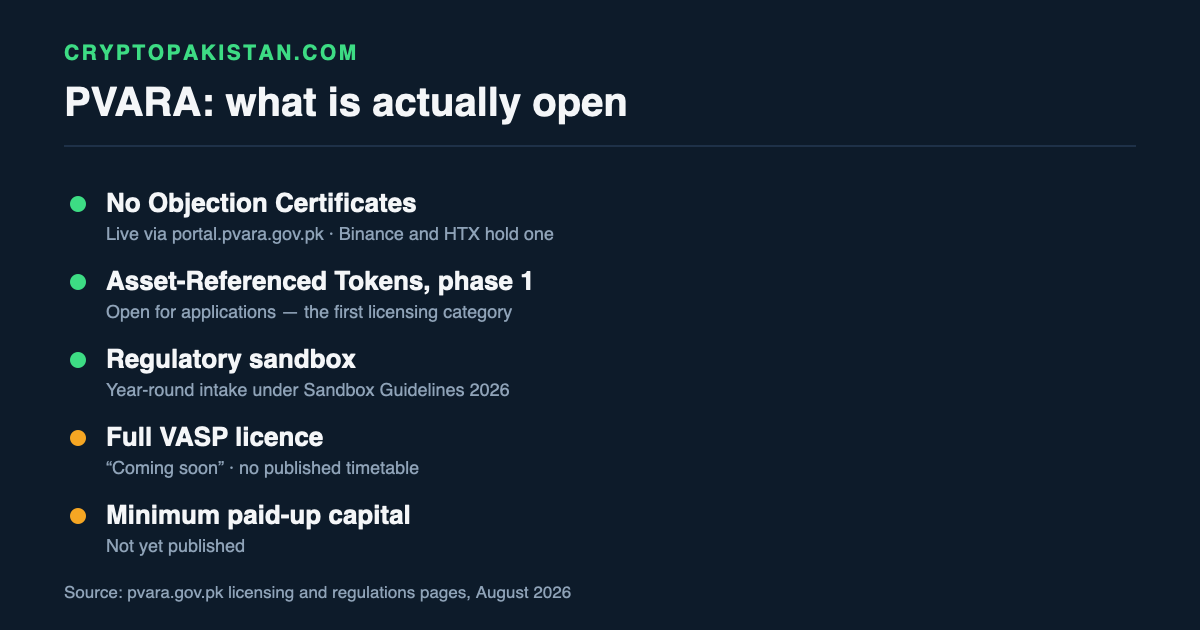
Three things are live, and it is worth being precise about each, because "Pakistan is licensing crypto" is being said far more loosely than the facts support:
- No Objection Certificates. Applications go through PVARA's NOC portal. An NOC is regulatory clearance to proceed — not a licence. Binance and HTX hold NOCs; Bitget is reported to have entered the pipeline.
- The regulatory sandbox. PVARA has published incubation guidelines for firms wanting to test under supervision before committing to a full application.
- Full VASP licences, across all eleven Schedule-I categories — including Asset-Referenced Token issuance, which is no longer a distinct first phase. PVARA notified the Virtual Asset Services Regulations, 2026 (S.R.O. 1419(I)/2026) on 21 August 2026.
No company has yet been granted a full licence.
What a full licence will require
PVARA has published the bar in advance, which is unusually helpful. Applicants will need to be a company registered in Pakistan under the Companies Act 2017, meet minimum paid-up capital set by licence category, pass fit-and-proper checks on directors and key personnel, run KYC and transaction-monitoring systems, register with the Financial Monitoring Unit, and maintain cybersecurity and disaster-recovery arrangements. Records must be kept for a minimum of ten years.
Eleven licence categories are priced in Schedule-I to the notified regulations: Advisory Services, Broker-Dealer Services, Custody Services, Virtual Asset Management and Investment Services, Virtual Asset Transfer and Settlement Services, Fiat-Referenced Token Issuance, Asset-Referenced Token Issuance, Exchange Services, Lending and Borrowing Services, Virtual Asset Derivatives Services, and Mining Related Virtual Asset Services.
What this means for Pakistani users
- No platform in Pakistan is fully licensed yet. If an exchange tells you it is "PVARA licensed," it is at best describing an NOC. Treat the claim with scepticism and check the licence tracker.
- Asset-backed tokens are the first regulated on-ramp. If a compliant gold-backed or reserve-backed token reaches the Pakistani market, this is the process that will have produced it.
- Nothing here changes your tax position. Gains remain taxable under existing Income Tax Ordinance provisions; the crypto-specific regime discussed in Budget 2026-27 is still only a proposal.
- The barrier to entry is high. Paid-up capital, a Pakistani subsidiary and FMU registration mean the licensed market will be small and institutional, not a long tail of local startups.
What we're watching
Three signals. Whether any ART application is actually approved, and what it references. Whether the first full licence — in any category — is actually granted. And whether the minimum paid-up capital figures PVARA has now published (Schedule-I, S.R.O. 1419(I)/2026, PKR 15 million to PKR 500 million by category) are within reach of a domestic firm rather than only a foreign exchange with a Karachi subsidiary — the figures notified are lower than the ones PVARA consulted on, and that gap is worth watching, not just the existence of a number.
Sources
- PVARA — VASP Licensing (primary)
- PVARA — Regulations, guidelines and circulars (primary)
- PVARA — News & Updates (primary)
- Virtual Assets Act, 2026 — full text as passed by the National Assembly (primary, PDF)
- PVARA — NOC application portal (primary)
Correction, 6 August 2026. An earlier version of this article said that a reserve-backed stablecoin was “broadly” an asset-referenced token. That was wrong. The Virtual Assets Act, 2026 defines Asset-Referenced Tokens and Fiat-Referenced Tokens as distinct categories, and a stablecoin pegged to a single official currency falls under the latter. We have corrected the section above and quoted the statutory definitions directly. The error came from relying on the general international usage of the term rather than the Act’s own wording.
Correction, 25 August 2026. This piece's lead described Asset-Referenced Token issuance as the sole open licensing phase, with the full VASP licence "coming soon." That was PVARA's own published framing, archived from its licensing page as recently as 22 July 2026. It has since been overtaken: PVARA notified the Virtual Asset Services Regulations, 2026 (S.R.O. 1419(I)/2026) on 21 August 2026, opening applications across all eleven Schedule-I licence categories, not ART alone. The piece has been updated above. No company holds a full licence as of this correction.