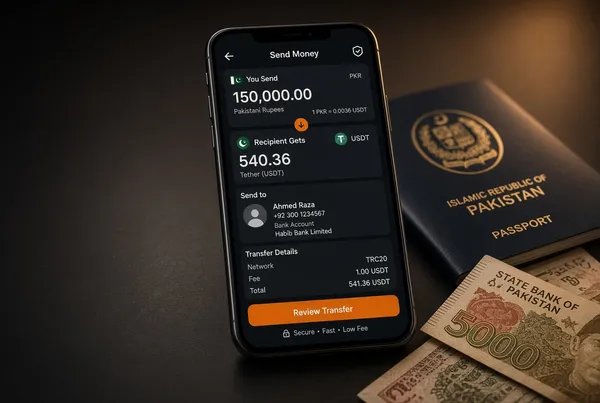
Remittances were $3.6bn in September, up 12.7%. USDT still costs more
Pakistanis abroad sent $3.6 billion home in September, the third month since the State Bank stopped paying for free transfers. On P2P markets, USDT stayed above the official rate every day.


Key takeaways
- September remittances were $3.6 billion, up 12.7% on a year earlier and down 1.9% on August, according to the State Bank.
- July to September totalled $10.9 billion, against $9.5 billion a year earlier: growth of 14.0%, by the State Bank's calculation.
- USDT on P2P stayed above the official rate every day in September. The median premium was 2.58%, against 2.70% in August.
- September is the last month before the banks' Pasban prize scheme began counting remittances on 1 October.
The third month
When the State Bank stopped reimbursing banks for free remittance transfers in July, we said we would watch whether money sent home slowed. The first two months did not show it: $7.29 billion arrived in July and August, up 14.7%, according to the Ministry of Finance.
September did not break the pattern either. The State Bank's release of 9 October puts workers' remittances at $3.6 billion for the month. That is 12.7% more than in September 2025, though 1.9% less than in August. Over the first quarter of the fiscal year, July to September, $10.9 billion came in, against $9.5 billion a year earlier. The State Bank puts the growth at 14.0%, calculated on unrounded figures.
Saudi Arabia was again the largest source, at $899.1 million, followed by the UAE at $748.5 million, the UK at $515.1 million and the US at $305.9 million. Saudi Arabia and the UAE together sent about $1.65 billion, roughly 46% of the month's total.
Where the money went, and what it cost
The banking industry says it now carries the cost the State Bank used to pay. In the State Bank's 25 September release launching the Pasban prize scheme, the Pakistan Banks Association said banks had taken over "the Rs. 80 billion remitter incentive". Pasban itself only counts money received from 1 October, so it plays no part in September's figure.
On peer-to-peer markets, the gap did not close. Every day in September, USDT traded above the official rate in our daily series. The median premium was 2.58%, slightly below August's 2.70%. On 12 October it was 2.47%, with USDT at about Rs284.06 against an official reference of Rs277.21. Track it on our USDT rate page.
We are not going to attribute the premium to remittance flows, or the other way round. Our series starts on 6 August, so we cannot yet compare it with a year earlier.
What this means for Pakistani users
- The formal route is still growing, more slowly. September was up on a year earlier but slightly down on August. Banks have kept transfers free since the reimbursement ended.
- From October, bank remittances can earn prize entries. Families receiving at least $100 a month through a bank account for three straight months qualify for Pasban draws. The first draw is on 15 January 2027.
- Converting through USDT has its own cost. At a premium of about 2.5%, Rs100,000 spent on USDT through P2P buys roughly 2.5% fewer dollars than at the official rate. No P2P platform holds a PVARA licence.
- This is a measurement, not advice.
What we're watching
- October's figure, the first month inside Pasban's qualifying period, due from the State Bank in early November.
- Whether the P2P premium stays inside the 2% to 4% band it has held since August.
- Whether banks publish how many families qualify for Pasban.
Sources
- State Bank of Pakistan, Press Release of Workers' Remittances for September 2026, 9 October 2026.
- Ministry of Finance, Monthly Economic Update & Outlook, September 2026.
- State Bank of Pakistan, Pasban Remittance Reward Scheme press release, 25 September 2026.
- Associated Press of Pakistan, Workers' remittances increase by 8.41% in first quarter, for the July–September 2025 baseline.
- CryptoPakistan P2P series, daily readings 6 August to 12 October 2026: USDT rate in Pakistan.