What PVARA Is, and What It Can and Cannot Regulate
PVARA, created by the Virtual Assets Act, 2026, licenses crypto businesses, not holders. What that means for Pakistani crypto users.

Key takeaways
- PVARA is a statutory authority established by section 6 of the Virtual Assets Act, 2026, gazetted on 5 March 2026.
- Its board includes the State Bank of Pakistan Governor and the SECP Chairperson, alongside a government-appointed Chairperson.
- The Act applies to service providers and issuers, not to individuals who hold crypto.
- The Act requires PVARA to publish a register of licensees. As of 25 September 2026, its website carries none.
The Pakistan Virtual Assets Regulatory Authority, known as PVARA, was established by section 6(1) of the Virtual Assets Act, 2026, published as Act No. XIII of 2026 in the Gazette of Pakistan (Extraordinary) on 5 March 2026. The gazette is the government's official journal of record. Section 1(3) brings the Act into force at once.
It is the body that licenses and supervises the businesses Pakistanis use to buy, sell and hold crypto. It does not license the people who use them.
What kind of body PVARA is
Under the Act, PVARA is a body corporate with perpetual succession and a common seal, which may sue and be sued in its own name (s.6(2)). It is autonomous in performing its functions, subject to the Act (s.6(3)), and its headquarters are in Islamabad (s.6(4)). Section 5(3) vests the regulation and supervision of virtual assets and virtual asset service providers "primarily in the Authority", in coordination with other regulators where applicable.
That makes PVARA a statutory authority, created by an Act of Parliament. Before the Act, a Virtual Assets Ordinance, 2025 (VII of 2025) was in place; an ordinance is the temporary form of law the government can issue when Parliament is not sitting. Section 74 of the Act says that anything done, any appointment made and any notification issued under that Ordinance, which has lapsed, is treated as done under the Act.
One oddity in the primary documents: section 6 establishes the "Pakistan Virtual Assets Regulatory Authority" (with an "s"), while the Act's definitions clause (s.3(1)(ii)) and the preambles of both regulations notified on 21 August 2026 say "Pakistan Virtual Asset Regulatory Authority". This article uses the section 6 form.
Who sits on the board
Section 7(1) of the Act sets the board: a Chairperson appointed by the Federal Government; the Secretaries of the Ministries of Finance and of Law and Justice; the Governor of the State Bank of Pakistan (SBP); the Chairperson of the Securities and Exchange Commission of Pakistan (SECP); the Chairman of the National AML-CFT Authority (the anti-money-laundering and counter-terrorism-financing body); the Chairperson of the Pakistan Digital Authority; and two independent directors, also appointed by the Federal Government. Members who do not sit ex officio serve three years and can serve one further three-year term (s.7(2)).
The heads of the central bank and the securities regulator sit on PVARA's own board, so overlap between the three bodies is handled inside the Authority as well as between institutions. Section 11(1) leaves the Chairperson's appointment and terms to the Federal Government and requires expertise in digital finance or technology and at least three years' relevant experience. PVARA's home and about pages, fetched 25 September 2026, do not name a Chairperson.
What it is empowered to do
Under section 9(1) of the Act, PVARA's functions include licensing, regulating and supervising virtual asset service providers (VASPs, the businesses that run exchanges, custody, brokerage and similar services) and token issuers; protecting customers and investors, including through measures against money laundering and terrorist financing; and attracting investment to Pakistan. The mandate is promotional as well as protective, and the Act says so in terms.
Section 9(1)(f) lets PVARA assess and classify any virtual asset, service, activity, offering, issuer or provider by its substance, function or economic effect, "irrespective of the nomenclature, structure, or designation assigned to it", in consultation with the SBP or SECP where the asset falls within their mandates. A token's own label does not decide whether PVARA treats it as a virtual asset. The Act does not say how PVARA will use the power.
Section 9(2) lists the tools: making regulations, standards and directives; issuing, varying, suspending and revoking licences; on-site inspections and off-site monitoring; administrative sanctions; applying to court for civil or criminal remedies; levying fees; and operating regulatory sandboxes. Section 35 lets PVARA set up a sandbox, a supervised space for testing products under controlled conditions.
What it regulates, and what it does not
Section 2(1) applies the Act to VASPs that carry on virtual asset services in or from Pakistan and to issuers that offer or distribute virtual assets in or from Pakistan. It names businesses, not individual holders. We set out that scope in Virtual Assets Act Regulates Businesses, Not Crypto Holders (4 September 2026) and the legal position in Is Crypto Legal in Pakistan? What the Virtual Assets Act Says (18 September 2026).
The definitions clause, s.3(1)(xxxi), states that virtual assets are not legal tender. Section 2(2) lists six exclusions from the Act, (a) to (f). They include non-fungible tokens or digital collectibles that do not amount to virtual assets given their substance, function or economic effect, so the Act does not say all NFTs are outside its scope. Clause (f) allows PVARA itself to exclude further digital representations of value.
On services, the Act's Schedule I lists ten categories: advisory; broker-dealer; custody and administration; exchange; lending and borrowing; derivatives; management and investment; transfer and settlement; issuance; and mining-related services. PVARA's licensing page, fetched 25 September 2026, lists eleven. The difference comes from Schedule I of the Pakistan Virtual Asset Services Regulations, 2026, which splits issuance into fiat-referenced and asset-referenced token issuance. Mining for one's own account is excluded; the mining category covers services to third parties involving customer assets or funds.
What this means for Pakistani users
- Holding crypto does not need a PVARA licence. The Act's scope in section 2(1) is service providers and issuers. An individual buying and holding crypto is not one of them.
- Paying for things in crypto is restricted. Regulation 3(6) of the Pakistan Virtual Asset Services Regulations, 2026 (S.R.O. 1419(I)/2026, in force since 21 August 2026) says: "Virtual assets shall not facilitate, or be used or recognized as, a means of payment for domestic commercial transactions, except where specifically approved by the State Bank of Pakistan pursuant to Section 9(1)(f) of the Act." The clause does not say whether it reaches individuals or only licensed businesses, and it is not a ban on holding crypto.
- There is no register to check a platform against yet. Section 21(4) of the Act requires PVARA to maintain and publish on its website an up-to-date register of licensees, with each one's name, licence number, permitted services and regulatory status. As of 25 September 2026, PVARA's licensing page lists three routes (regulatory sandbox, No Objection Certificate, VASP licence) and publishes no such register, and its news page announces no licence grant. A No Objection Certificate (NOC) is not a licence: regulation 6(4)(a) of the same regulations says so. Our PVARA licence tracker follows which firms hold what.
- The protections are aimed at the platform. Customer-asset segregation, capital and disclosure duties fall on licensees. For what that means for a buyer, see Buying Bitcoin in Pakistan: The Platform Is Vetted, Not You (7 September 2026).
What we're watching
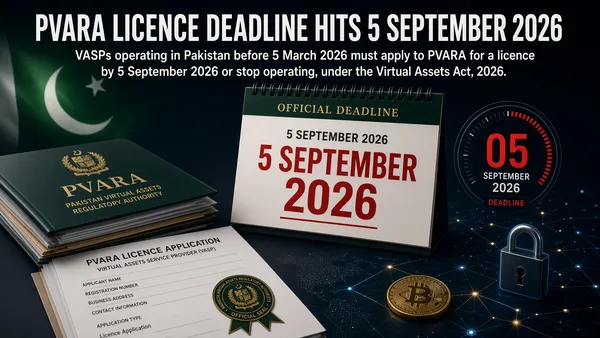
On 21 August 2026 PVARA notified two sets of regulations: S.R.O. 1419(I)/2026, on licensing and regulation of VASPs, and S.R.O. 1420(I)/2026, the activity-specific rules for each licence category. Both are in force. For deadlines, see Binance and HTX's PVARA Licence Deadline Falls Around 21 November (14 September 2026) and PVARA Licence Deadline Hits 5 September 2026 (2 September 2026).
PVARA's news page, fetched 25 September 2026, shows no item later than 12 December 2025, a link to press coverage of the Binance and HTX No Objection Certificates. PVARA has not published a licensing timetable that this article can cite. The first register of licensees under section 21(4), and PVARA's own site naming its Chairperson, are the next things that would change this picture.
Sources
- Gazette of Pakistan (Extraordinary), Part I, 5 March 2026: Virtual Assets Act, 2026 (Act No. XIII of 2026)
- S.R.O. 1419(I)/2026, Pakistan Virtual Asset Services Regulations, 2026, notified 21 August 2026
- S.R.O. 1420(I)/2026, Pakistan Virtual Asset Services Activity Specific Regulations, 2026, notified 21 August 2026
- PVARA licensing page, fetched 25 September 2026
- PVARA news page, fetched 25 September 2026