Tokenizing Pakistani Property: What the Law Actually Allows
The Virtual Assets Act defines asset-referenced tokens broadly enough to cover real estate — and PVARA has opened applications. What is missing is everything underneath.

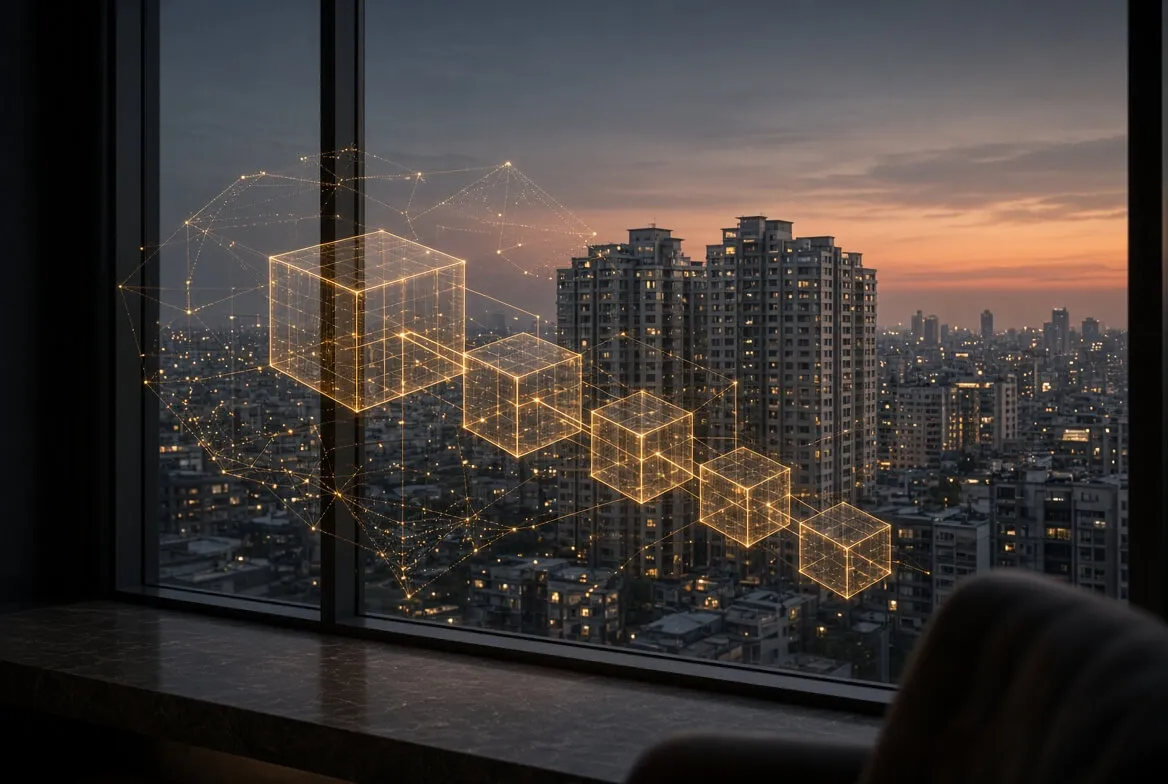
Property is how Pakistan saves. Not equities, not bonds — land and buildings. It is also the most illiquid asset a Pakistani household can own, transacted in large indivisible tickets, with title records that vary in quality by province and a diaspora that sends home $41.6 billion a year, a large share of which ends up in exactly this asset class.
Tokenization is the obvious technical answer to illiquidity and indivisibility. So the question worth asking is a narrow one: does Pakistani law permit it?
What the Act actually says
We read the definition in the Virtual Assets Act, 2026 as passed by the National Assembly. Section 2 defines an Asset-Referenced Token as a virtual asset that represents, directly or indirectly:
“ownership rights, claims, or economic interests, including entitlements to receive or share income, returns, or other economic benefits, in respect of one or more underlying assets, or is designed to maintain a stable value by reference to such underlying assets.”
That is drafted broadly, and deliberately so. A token conveying a share of the rental income from a building falls inside it. So does one representing a fractional ownership claim on the building itself. Real estate is not named — but nothing in the definition excludes it, and “economic interests… in respect of one or more underlying assets” is close to a textbook description of fractional property ownership.
Note what the Act does not lump in here. A currency-pegged stablecoin is a separate defined category — a Fiat-Referenced Token, meaning one that “purports to maintain a stable value relative to a single Official Currency of any country and is redeemable at par value by its Issuer.” The ART category is the tokenized-real-world-asset category. That is the one PVARA has opened first-phase applications for.
Who counts as an issuer
The Act defines an Issuer as the legal person that originates or creates a virtual asset and retains primary control over its initial supply, reserve assets or on-chain governance. It adds an explanation that matters commercially: a person is not an issuer merely by marketing, advertising, facilitating secondary-market trading, or providing technical development — without control over issuance, supply or reserve assets.
For a property tokenization structure, that draws the regulatory line around the entity holding the asset and controlling the token supply, not the estate agent or the software vendor.
What is missing — and it is nearly everything
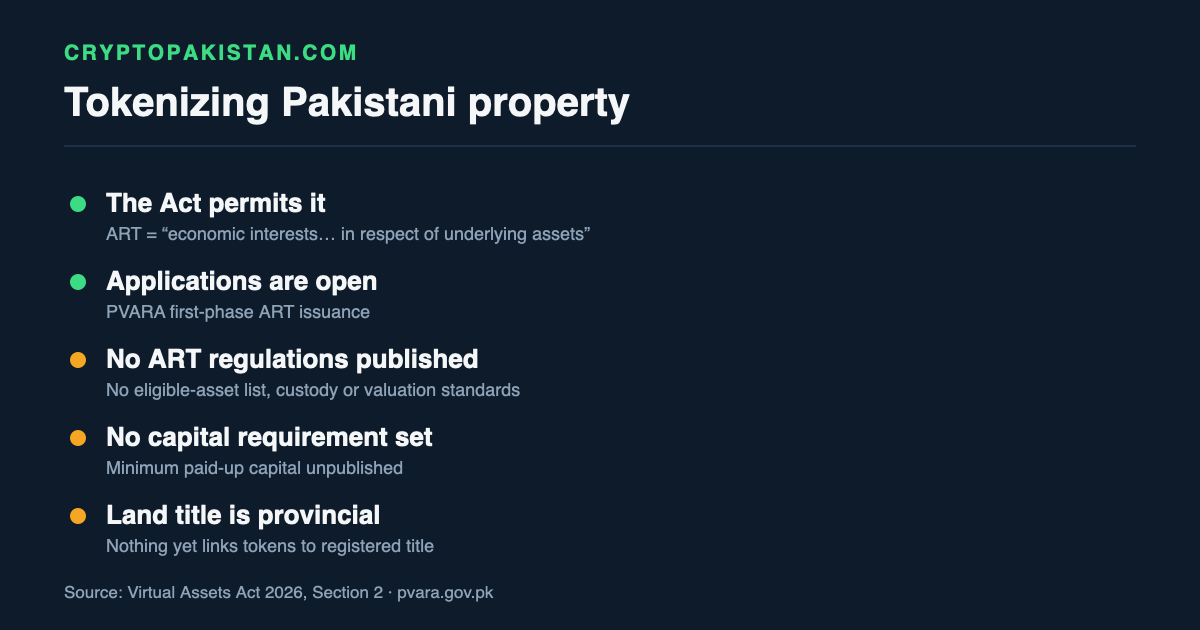
The enabling definition exists. The operational rules do not. As of today PVARA has published the Act, NOC regulations and sandbox guidelines. It has not published:
- Detailed ART regulations, or an eligible-asset list confirming real estate qualifies
- Custody and verification requirements — who holds the title, and who audits that it exists
- Valuation and reporting standards for the underlying asset
- Minimum paid-up capital for an ART issuer
- Any interaction with provincial land-record systems, which is where Pakistani property title actually lives
That last one is the hard problem, and it is not a blockchain problem. A token is only as good as the legal claim behind it. Pakistani land title is administered provincially, with digitisation at very different stages across Punjab, Sindh, KP and Balochistan. Until a token can be reliably tied to a registered title, tokenized property is a claim against an issuer, not against a building.
What this means for Pakistani users
- Nobody is licensed to do this yet. Applications are open; no ART issuer has been approved. Any offer to sell you tokenized Pakistani property today is operating ahead of the framework.
- Ask what the token is a claim on. A share of a company that owns a building is a very different instrument from a registered interest in the land itself, and only one of them survives the issuer going under.
- “Fully backed” has no published Pakistani standard yet. Treat backing claims as marketing until PVARA defines and audits them.
- There is a legitimate route in. Firms wanting to build this can approach PVARA through the regulatory sandbox, a no-action relief letter, or the NOC process rather than launching and hoping.
A transparency problem worth naming
The Virtual Assets Act, 2026 is published on PVARA's site as a 12.3 MB scanned image — 36 pages of JPEGs with no text layer. It cannot be searched, copied, or read by a screen reader, and quoting it requires reading the scan by eye. We did that for this article.
This is not a small thing. It is the primary legislation governing an entire emerging industry, and the practical effect is that most coverage relies on secondary summaries of a document almost nobody has actually read. That is precisely how unverified claims — hash-rate thresholds, tax rates, eligible asset lists — enter circulation and harden into “facts”. A machine-readable text version would cost PVARA nothing and would measurably improve the quality of reporting about it.
What we're watching
Whether PVARA publishes ART regulations naming eligible asset classes, whether any approved ART references Pakistani real estate rather than a commodity, and whether any provincial land authority engages with the framework. We track approvals on the PVARA licence tracker.
Sources
- Virtual Assets Act, 2026 — as passed by the National Assembly (primary; definitions quoted from Section 2)
- PVARA — VASP Licensing, Asset-Referenced Token phase one (primary)
- PVARA — Regulations, guidelines and circulars (primary)
- State Bank of Pakistan — workers' remittances data (primary)